Mục lục
Have you just taken your Gelato out of the freezer, only to see those beautiful swirls soften within minutes, lose their shape, release water, and no longer maintain their original structure?
Don't be too quick to assume that the only problem is that “the freezer isn't cold enough.”
In reality, Gelato's resistance to melting is the result of an entire system: water content, sugar, total solids, fat, PAC/POD, Stabilizer, pasteurization, rapid freezing, and storage conditions.
A recipe can produce Gelato that is very soft and easy to scoop but melts extremely quickly. Conversely, Gelato may hold its shape well but be too hard, lack smoothness, and fail to deliver the desired eating experience.
FABBRI 1905 also develops its Base systems based on various formulation factors, including milk powder, fat, protein, fiber, Stabilizer, Emulsifier, and different types of sugars.
In this article, IKEM will analyze the 9 most common causes of fast-melting Gelato and explore practical approaches to improving each one.
This is one of the most important causes.
Gelato inevitably contains water. However, the key question is how much of that water becomes ice and how much remains unfrozen.
If the recipe contains:
Too much water
Low total solids
Insufficient sugar to control the freezing point
A structure that does not have enough water-binding capacity
Gelato will tend to become soft quickly when exposed to ambient temperatures.
You should not simply “reduce the water.”
Instead, evaluate the recipe as a whole:
Water → Sugar → Total Solids → PAC → Stabilizer → Fat/Protein
The goal is to create a balanced structure in which water is properly controlled rather than existing excessively as free water.
Many beginners think:
“Sugar is only used to make Gelato sweet.”
This is an incomplete understanding.
In Gelato, sugar also affects the freezing point and the amount of water that freezes, directly influencing softness, scoopability, and melting rate.
Different types of sugar do not have the same effect.
For example, a recipe may contain:
Sucrose
Dextrose
Glucose syrup/glucose powder
Fructose
Maltodextrin
Other carbohydrates
FABBRI also uses different types of sugars and sweetening ingredients in its Base systems, depending on the purpose and formulation.
Gelato may become:
PAC too high → too soft → melts quickly
or:
PAC too low → too hard → difficult to scoop
Therefore, adding more sugar does not automatically make Gelato better.
What matters is selecting the right type of sugar and using it at the appropriate ratio.
PAC is a parameter commonly used in Gelato technology to evaluate the antifreeze effect of a formulation and its influence on the freezing point.
A recipe with high PAC tends to maintain a larger unfrozen phase at serving temperature, making Gelato softer and easier to scoop.
However, if PAC is too high, the result may be:
Gelato that is too soft
Gelato swirls that quickly collapse
Gelato that melts easily at room temperature
Difficulty creating attractive shapes in the display case
A short serving window outside the freezer
Special attention should be paid to ingredients with naturally high sugar content, such as fruit, puree, chocolate, sauces, syrups, and flavor pastes. These ingredients can significantly change the sugar balance of a recipe.
Do not calculate only the amount of added sucrose.
Consider the total amount of actual sugars contributed by all ingredients.
If PAC is closely related to the antifreeze effect, POD is commonly used to evaluate relative sweetness.
Two recipes may contain similar amounts of sugar but still have different:
Sweetness levels
Softness
Shape retention
This happens because different sugars have different sweetness levels and different effects on the freezing point.
Therefore, Gelato balancing should not be based simply on the question:
“How many grams of sugar do I need?”
Instead, ask:
“Which type of sugar do I need, and at what ratio, to achieve the appropriate sweetness and PAC/POD balance?”
This is precisely why professional Gelato formulation requires calculation rather than relying entirely on trial and error.
This is a commonly overlooked cause.
Total Solids play an important role in creating body, mouthfeel, and structure in Gelato.
If the recipe contains too much water but too little:
Milk powder
Protein
Sugar
Fat
Fiber
Other solid ingredients
the Gelato structure will be weak.
When exposed to serving conditions, that structure can become unstable and melt more quickly.
FABBRI states that its Base systems are selected based on the composition and quality of various factors such as milk powder, fat, protein, fiber, Stabilizers, Emulsifiers, and sugars.
Instead of simply increasing the fat content, evaluate the total solids of the entire recipe.
A great Gelato does not necessarily need a high fat content.
What matters is creating a balanced structure between water – sugar – protein – fat – total solids – Stabilizer.
Stabilizer plays an important role in water management, structural support, and limiting the development of ice crystals.
However, it is also an ingredient that can easily be misused.
May result in:
Weak structure
Poor water control
Gelato quickly losing its shape
Ice crystals developing more easily during storage
On the other hand, excessive Stabilizer may cause:
Gelato to become too thick
A gummy mouthfeel
A sticky sensation
Loss of a clean eating experience
Therefore:
Stabilizer is not a “cure-all” for fast-melting Gelato.
If the recipe is already incorrect in terms of sugar, water, or total solids, simply increasing Stabilizer may not solve the problem.
Studies on the melting behavior of frozen desserts also indicate that Stabilizers can contribute to maintaining structure during melting, but their effectiveness depends on the type of Stabilizer and the overall formulation.
This is a production technology factor, not simply a formulation issue.
After Gelato leaves the batch freezer, its structure continues to change.
If freezing/hardening takes too long, ice crystals have more time to grow.
The result may be:
Larger ice crystals
Less smooth texture
Weaker structure
Gelato that loses its shape more easily
Faster melting and poorer appearance when exposed to higher temperatures
Therefore, the batch freezer and blast freezer should not be overlooked.
Rapid freezing helps reduce the time available for large ice crystals to form and supports the preservation of the product's structure.
Some specialized blast freezers are designed to rapidly lower the core temperature of Gelato, helping promote the formation of smaller ice crystals.
Even a well-formulated recipe can experience problems if the storage equipment is not suitable.
Common causes include:
The freezer is too warm
Frequent temperature fluctuations
The door is opened too often
The freezer is overloaded
Uneven cold-air circulation
Gelato is placed in a warmer area of the freezer
The equipment has not reached a stable temperature before the product is loaded
In particular, it is important to distinguish between:
Storage Temperature ≠ Serving Temperature
Gelato is designed to be served in a softer state than conventional industrial ice cream.
Therefore, the recipe should be balanced according to the actual serving temperature of the shop, rather than simply relying on the temperature displayed by a particular freezer.
Even when the recipe and equipment are both good, Gelato can still melt quickly if the operating process is not consistent.
Some common mistakes include:
Gelato continuously absorbs heat from the environment → the ice phase begins to melt → the structure becomes weaker.
Repeated temperature changes can weaken the Gelato structure and accelerate changes in ice crystal structure.
Exposure to air and temperature fluctuations can negatively affect the surface and structure.
After leaving the batch freezer, Gelato needs an appropriate subsequent cooling/hardening process before being placed on display.
Creating multiple grooves, increasing the exposed surface area, and leaving the structure uneven can also make it more difficult to maintain an attractive appearance.
Instead of addressing just one cause, evaluate your Gelato across these 7 key areas:
| Factor | What to Check |
|---|---|
Related news news
19.09.2026
Matcha Gelato – Balancing Bitterness and Sweetness for Authentic Gelato Quality
Discover how to create Matcha Gelato with the perfect balance of bitterness and sweetness. Learn how to select the right Matcha, balance sugar and fat, and apply proper techniques to achieve a smooth and creamy Gelato with a distinctive tea aroma and an appealing green color.
29.08.2026
Chocolate Gelato – How to Create Rich, Smooth Chocolate Flavor in Authentic Italian-Style Gelato
Discover how to make rich, smooth, and well-balanced Chocolate Gelato. Explore FABBRI ingredients and professional Gelato solutions from IKEM.
28.08.2026
What Is Sorbetto? How Is Sorbetto Different from Gelato? The Secrets to Creating Authentic Italian-Style Sorbetto
What Is Sorbetto? Discover the Differences Between Sorbetto and Gelato in Terms of Ingredients, Texture, Flavor, and Formulation Balancing. Explore FABBRI Ingredients with IKEM.
26.08.2026
What Is Matcha Gelato? Why Is Matcha Ice Cream Still So Popular?
What Is Matcha Gelato? Discover the Appeal of Matcha Ice Cream and Learn How to Balance Matcha Flavor, Creaminess, and Sweetness to Create Smooth, Creamy, and Delicious Matcha Gelato with Fabbri 1905 Ingredients.
24.08.2026
Dextrose, Glucose Syrup and Sucrose: What’s the Difference? Understanding Them to Properly Balance Your Gelato.
Dextrose, Glucose Syrup and Sucrose: What’s the Difference? Understanding Them to Properly Balance Your Gelato.
21.08.2026
Pistachio Gelato – The HOT Flavor Trend of 2026: Why Pistachio Gelato Is Becoming Increasingly Popular
Discover Pistachio Gelato – The HOT Flavor of 2026. Explore how to choose the right ingredients, balance your recipe, and discover FABBRI 1905 pistachio products with IKEM.
18.08.2026
Should You Use Whipping Cream in Gelato? How to Balance Richness, Texture & Flavor with FABBRI 1905 Ingredient
Should you use whipping cream in gelato? Learn how cream affects fat and solids, and discover how to create smooth, creamy and stable gelato with professional FABBRI 1905 ingredients.
15.08.2026
Why Is Gelato Typically Served at -12°C to -14°C? The Secret Lies in Its Structure
Discover why Gelato is typically served at -12°C to -14°C, and explore the roles of PAC, sugars, water, total solids, Batch Freezers, and Blast Freezers in creating Gelato that is smooth, creamy, elastic, and stable.
13.08.2026
THE ROLE OF MILK POWDER IN GELATO: THE “MISSING PIECE” FOR CREATING THE PERFECT TEXTURE
Milk powder does more than provide a milky flavor. It also plays an important role in increasing total solids, adding protein, supporting water retention, and improving the structure of Gelato. When properly balanced within the recipe, milk powder contributes to creating Gelato that is smooth, elastic, full-bodied, and more stable.
10.08.2026
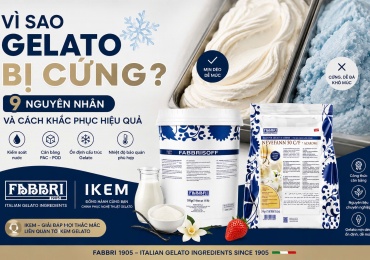
Why Is Your Gelato Hard? 9 Causes and Solutions for Smooth, Creamy, and Easy-to-Scoop Gelato
Why does Gelato become hard, difficult to scoop, and develop ice crystals? This is a common issue when the recipe or storage process is not properly balanced. In this article, IKEM will help you discover the 9 most common causes of hard Gelato, from water content, sugar systems, PAC/POD, total solids, and fat content to stabilizers, freezing processes, and storage temperatures.
You will also discover how FABBRI 1905 Gelato Base can help optimize your recipe, creating Gelato with a smooth, elastic, creamy texture that is easy to scoop and more stable over time. Join IKEM to explore the essential knowledge and techniques for creating high-quality, consistent Gelato in every batch.
09.08.2026
How to Balance a Gelato Recipe – The Secret to Creating Authentic Italian Gelato with a Smooth, Elastic Texture, Slow Melt, and Consistent Quality
Recipe balancing is the core factor that determines the quality of Gelato—from its smoothness and elasticity to its ability to hold its shape and deliver a well-balanced flavor.
This article will help you understand the essential roles of water, fat, sugars, PAC, POD, total solids, and stabilizers in developing a perfectly balanced Italian-style Gelato recipe.
You will also discover how FABBRI 1905 Gelato Bases can simplify recipe formulation, optimize texture and stability, and help you produce consistently high-quality, professional Gelato, with the expert support and guidance of IKEM.
07.08.2026
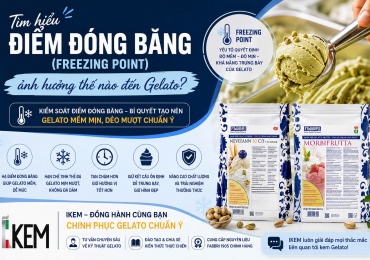
How Does the Freezing Point Affect Gelato? The Secret to Creating Smooth, Authentic Italian Gelato with FABBRI 1905 Gelato Base
The freezing point is a key factor that determines the softness, smoothness, shape retention, and overall quality of Gelato. In this article, IKEM explains how the freezing point influences Gelato structure, explores the relationship between the freezing point, PAC, and POD, and shares practical ways to optimize your recipe to reduce ice crystal formation and create authentic Italian-style Gelato. Discover how FABBRI 1905 Gelato Bases help simplify recipe formulation, improve product consistency, and deliver stable, high-quality results in every batch. Whether you're new to Gelato or an experienced professional, IKEM is always ready to provide expert guidance and support you on your journey to mastering authentic Italian Gelato.
06.08.2026
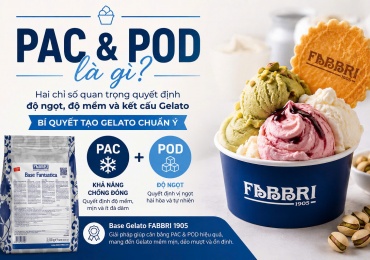
What Are PAC and POD? The Two Key Factors That Determine the Sweetness, Softness, and Texture of Authentic Italian Gelato with FABBRI 1905 Gelato Base
Overrun is the measure of the amount of air incorporated into Gelato during the batch-freezing process, directly influencing its smoothness, elasticity, shape retention, and flavor. Discover how overrun works and learn how to control it effectively to create authentic Italian Gelato with the support of FABBRI 1905 Gelato Bases.
06.08.2026
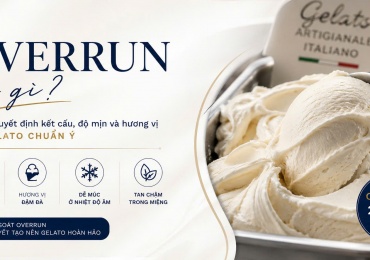
What Is Overrun? The Key Factor Behind the Smooth Texture, Volume, and Flavor of Authentic Italian Gelato
Overrun is the measure of the amount of air incorporated into Gelato during the batch-freezing process, directly influencing its smoothness, elasticity, shape retention, and flavor. Discover how overrun works and learn how to control it effectively to create authentic Italian Gelato with the support of FABBRI 1905 Gelato Bases.
05.08.2026
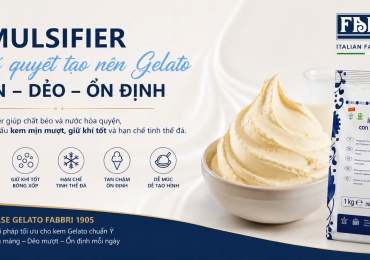
What Is an Emulsifier? How It Works and Its Role in Gelato – The Secret to Smooth, Creamy Texture with FABBRI 1905 Gelato Base
What is an emulsifier, and why is it essential in Gelato production? Discover how emulsifiers work, their role in creating a smooth, creamy texture, improving air incorporation, and enhancing product stability. Learn how FABBRI 1905 Gelato Bases provide a professional solution for producing authentic Italian Gelato with consistent quality and ease of production.
05.08.2026
How Do Stabilizers Work? The Secret to Creating Smooth, Creamy Gelato with FABBRI 1905 Base
How do stabilizers work in Gelato? Explore how they create a smooth, creamy texture, minimize ice crystal formation, and maintain a stable Gelato structure. Discover the premium FABBRI 1905 Gelato Base range, exclusively distributed by IKEM in Vietnam, designed for professional Gelato shops and large-scale production facilities.
01.08.2026
Gelato Base Explained: Why It's the Heart of Every Great Gelato Recipe
Discover how Gelato Base serves as the foundation of authentic Italian Gelato, delivering a smooth, creamy texture, superior stability, and exceptional flavor. Explore why professional Gelato artisans worldwide rely on premium ingredients from FABBRI 1905 to craft consistently outstanding Gelato.

31.07.2026
The Secret Behind Authentic Italian Gelato: It's More Than Just the Gelato Machine
What makes authentic Italian Gelato truly exceptional? It's not just the Gelato machine. Discover the key factors behind premium Gelato—from high-quality ingredients and scientifically balanced recipes to professional techniques and the right equipment—that create smooth, creamy, flavorful Gelato with authentic Italian taste.
01.07.2026
What is Gelato? Everything you need to know about authentic Italian gelato.
What is Gelato? Everything you need to know about authentic Italian gelato.
27.08.2026
What Is Coffee? From Coffee Beans to Your Cup
What Is Coffee? Discover the Journey from Coffee Beans, Roasting, and Grinding to Extraction, and Explore Coffee Brewing Knowledge with IKEM Beverage Training Academy.



|