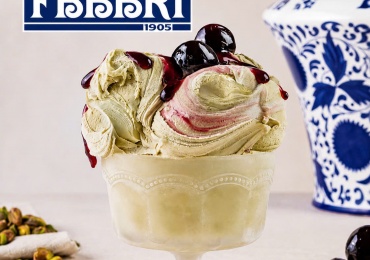
Why do many professional Gelato recipes use milk powder, especially Skim Milk Powder (SMP)? And how does using too little or too much milk powder affect the quality of Gelato?
When developing a Gelato recipe, milk powder is not simply an ingredient added to provide a milky flavor. It is also an important component that helps increase total solids, provide milk proteins, support water retention, improve structure, and create a smoother, more elastic texture.
In particular, for recipes that need to control fat content while still achieving good body, skim milk powder is a very useful tool for adjusting MSNF (Milk Solids-Not-Fat).
According to Gelato formulation-balancing principles, MSNF mainly consists of milk proteins, lactose, and certain minerals. These components directly affect the body, smoothness, and water-holding capacity of Gelato.
A delicious scoop of Gelato is determined by more than just flavor.
Behind a soft, pleasantly elastic Gelato that holds its shape beautifully and melts gently in the mouth lies a complex balance of water, sugar, fat, total solids, protein, stabilizers, and temperature.
Among these ingredients, milk powder is commonly used in milk-based Gelato recipes, yet its role is not always fully understood.
Why can two milk-based Gelato recipes produce such different results—one smooth, elastic, moderately rich, while another is icy, quick to melt, or too hard?
Part of the answer lies in how the Gelato maker controls milk solids and overall recipe balance.
This is also why professional ingredients such as FABBRI 1905 Gelato Bases are developed around a balance of multiple components, including milk powder, fat, protein, fiber, Stabilizers, and Emulsifiers.
Mục lục
Milk powder is a dairy product in which most of the water has been removed, concentrating the milk's solid components.
In Gelato, especially milk-based Gelato, milk powder can be used to add milk solids without necessarily increasing the fat content proportionally.
One type commonly used in professional Gelato formulation is:
Skim milk powder is particularly useful when the Gelato maker wants to:
This is why milk powder is not simply an ingredient used to create a “milky flavor.”
It is a technical tool used in Gelato recipe balancing.
Imagine a Gelato recipe containing too much water but not enough solids.
During freezing, excess water tends to form larger ice crystals.
The result can be:
Less smooth Gelato → A cold and icy sensation → Weak body → Poor texture
Conversely, when the recipe is properly balanced, the solid components help control free water and contribute to a more stable structure.
This is why, when developing a professional Gelato recipe, the Gelato maker needs to consider not only:
“How many grams of sugar?”
but also:
“What is the total solids content?”
“How much MSNF is present?”
“How much free water remains?”
“Are the PAC and POD appropriate for the recipe?”
This is one of its most important functions.
Total solids are the portion of the mixture remaining after water is excluded. In Gelato, controlling total solids has a major impact on eating quality and structural stability. Milk powder helps add solids to the recipe without introducing excessive amounts of water.
This is particularly useful when you want to:
Fresh milk = water + fat + milk solids
While:
Milk powder = concentrated source of milk solids
Therefore, milk powder gives the Gelato maker another “tool” for adjusting the ratio between water and solids in the recipe.
If you have ever tasted premium Gelato, you may notice the difference immediately.
Good Gelato typically does not feel:
❌ Too airy
❌ Too icy
❌ Too liquid
❌ Too hard
❌ Like it turns into water immediately
Instead, it offers a sensation that is:
This is what we refer to as the body of Gelato.
Milk proteins and other milk solids can contribute to increased viscosity and support the structure of the mix.
Therefore, milk powder can play an important role in creating a Gelato base with good body and a pleasant eating experience.
Milk powder does more than provide solids.
It also supplies milk proteins, which are important components of Gelato structure.
Proteins can interact with water and contribute to changes in the viscosity of the mix.
When used in a balanced recipe, milk proteins can support:
This helps explain why Gelato quality cannot be evaluated simply by looking at fat content.
A Gelato with high fat content does not necessarily have the best texture.
An important term in Gelato formulation is:
Simply put:
This group is mainly associated with:
When skim milk powder is used, the Gelato maker can add more milk solids-not-fat to the recipe.
This is one reason Skim Milk Powder often appears in Gelato recipes that need to control fat while still achieving good body.
Higher MSNF is not always better.
If MSNF is too low, the Gelato may lack body.
But if MSNF is too high, it can also create an imbalance, particularly when lactose levels become excessive.
Therefore, the important question is not:
“How much milk powder should I use?”
but:
One of the notable components of milk solids is lactose.
Lactose contributes to the solids system and affects the freezing characteristics of the mix.
However, this is also why Gelato makers should not arbitrarily increase milk powder.
If the milk solids and lactose content of the recipe become too high, lactose crystallization may occur under suitable conditions, potentially affecting the smoothness of Gelato.
Therefore:
A good Gelato recipe needs to find the right balance.
The answer is:
The melting rate of Gelato depends on many factors:
Milk powder can contribute to improved structure by adding milk solids and protein.
However, if the overall recipe is unbalanced, simply increasing milk powder will not solve the problem.
Imagine Gelato as a system in which many different components work together.
No single ingredient can “do everything.”
The quality of Gelato comes from:BALANCE.
This is also a key principle when choosing a professional Gelato Base system.
This is particularly important for those looking to develop professional Gelato.
FABBRI 1905 develops a range of Gelato Bases with different characteristics, allowing Gelato makers to choose according to:
In particular, FABBRI states that its Bases can be selected according to the presence and proportions of milk powder, fat, protein, fiber, Stabilizers, and Emulsifiers.
This shows that a professional Gelato Base is not simply “ice cream powder.”
It is a system of ingredients designed to help Gelato makers control the formulation and production process.
With extensive experience in Gelato ingredients, FABBRI develops a wide range of solutions for professional Gelatiere.
One example is Neve Free, a Base with a short ingredient list. FABBRI states that its ingredients include dextrose, low-fat milk powder, milk protein, and plant fiber.
The product is designed as a neutral Base and does not contain Emulsifiers, flavorings, or E-number additives.
What is important here is not only the individual product.
It is the underlying approach:
Every component needs to be placed in the right position within the Gelato balancing equation.
When a recipe needs additional milk solids but does not contain enough milk powder, you may experience:
However, you should not immediately conclude:
That would be an overly simplistic approach.
The entire recipe needs to be evaluated.
Conversely, too much milk powder can also create problems.
You may experience:
Therefore, an important principle is:
Milk powder is particularly useful in many milk-based Gelato varieties, such as:
19.09.2026
29.08.2026
28.08.2026
26.08.2026
24.08.2026
21.08.2026
18.08.2026
15.08.2026
10.08.2026
10.08.2026
09.08.2026
07.08.2026
06.08.2026
06.08.2026
05.08.2026
05.08.2026
01.08.2026

31.07.2026
01.07.2026
27.08.2026