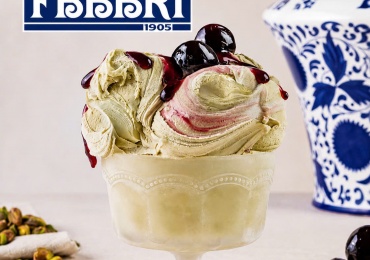
Gelato comes out of the machine soft and smooth, but just a few hours later, it becomes hard, difficult to scoop, and develops ice crystals?
This is a common issue, especially for people who are new to making Gelato. Some may think the problem lies with the Gelato machine, while others may try adding more sugar, milk, or Stabilizer to “save” the recipe. In reality, hard Gelato is often the result of an imbalance between the recipe, freezing process, and storage temperature.
A high-quality Gelato should not only taste delicious but also have a smooth, elastic, creamy texture that is easy to scoop and remains stable throughout storage.
So, why does Gelato become hard? What causes ice crystals in Gelato? Does adding more sugar always make Gelato softer? And how can this problem be fixed?
Let’s explore the root causes and solutions with IKEM, while also discovering the role of FABBRI 1905 Gelato Base in helping to balance Gelato recipes.
Mục lục
A good batch of Gelato should not be judged only by its color or flavor.
When enjoying Gelato, customers can clearly notice:
Is the Gelato easy to scoop?
Is the texture smooth or grainy?
Does it feel creamy or cold and dry?
Does the Gelato hold its shape well?
Does it melt smoothly on the tongue?
Does its quality change significantly during storage?
If Gelato is too hard, it becomes difficult for operators to scoop it with a spatula. If it contains too many ice crystals, customers will immediately notice a coarse, cold, and less smooth texture.
One particularly common situation is: Gelato looks beautiful and smooth when it comes out of the machine, but becomes hard after several hours in the freezer.
If this happens, do not immediately conclude that there is a problem with the machine.
Check the recipe first.
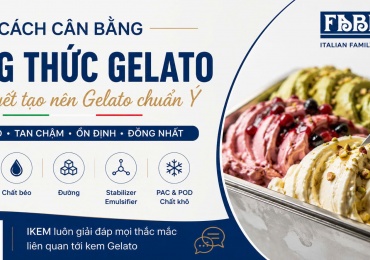
The softness and elasticity of Gelato can be understood as the result of a “balance system”:
WATER
↓
SUGAR
↓
PAC & POD
↓
TOTAL SOLIDS
↓
FAT & PROTEIN
↓
STABILIZER & EMULSIFIER
↓
FREEZING
↓
STORAGE TEMPERATURE
A change in just one factor can affect the texture of Gelato.
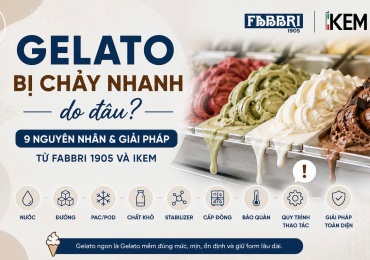
The 9 most common causes include:
Excessive free water
Low PAC
An unbalanced sugar system
Low total solids
An unsuitable fat ratio
Improper use of Stabilizer
An unbalanced fruit-based recipe
An unsuitable freezing process
Storage temperature that is too low or fluctuates
Let’s examine each cause in detail.
A particularly common situation is: “Gelato looks beautiful and smooth when it comes out of the machine but becomes hard after several hours in the freezer.” If this happens, do not immediately conclude that there is a problem with the machine. Check the recipe first.
This is one of the most important causes.
Gelato contains a certain amount of water. When the mixture is cooled, part of the water turns into ice crystals. If the recipe contains too much free water, the amount of frozen water increases.
As a result:
High free water
→ More water freezes
→ More ice crystals
→ Harder and less smooth Gelato
This commonly occurs in recipes that:
Contain too much added water
Use a high amount of fruit puree
Use a high amount of fruit juice
Have low total solids
Have not been rebalanced when ingredients are changed
Suppose you want a stronger mango flavor, so you increase the amount of mango puree.
However, mango puree does not only provide flavor.
It also contains:
water + natural sugars + solids + fiber.
When you increase the amount of puree, the overall balance of the recipe changes.
Therefore:
You cannot simply increase one ingredient to intensify the flavor while leaving the rest of the recipe unchanged.
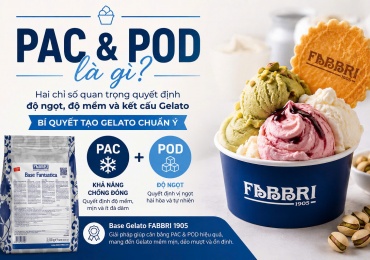
If we have to choose one particularly important parameter when analyzing hard Gelato, PAC is certainly one of the key factors to check.
Simply put:
Appropriate PAC
→ The amount of frozen water is controlled
→ Gelato has a softer, more elastic texture under suitable storage conditions
Conversely:
Low PAC
→ More water freezes
→ Gelato becomes harder
→ More difficult to scoop
It is important to understand that PAC is not the same as total sugar content.
A recipe can contain a high amount of sugar but still produce an undesirable texture if the sugar system is not properly balanced.
Therefore, when Gelato becomes hard, ask:
“Is the PAC of the recipe appropriate for the storage temperature?”
rather than simply asking:
“Have I added enough sugar?”
This is where the art of Gelato making begins to become a technical calculation.
If you simply increase sugar to make Gelato softer, you may unintentionally cause:
Higher sweetness → Higher POD → Unbalanced flavor
On the other hand, if you focus only on sweetness and ignore its effect on the freezing point, Gelato may become:
Too hard
Too soft
Too sweet
Difficult to hold its shape
The goal of a good Gelato recipe is to find the right balance between PAC – POD – total solids – water.
This is precisely why Gelato recipe balancing plays such an important role.
This is something many beginners easily misunderstand.
When Gelato becomes hard, the first reaction is often:
“Add more sugar!”
But the situation is not that simple.
In Gelato, sugar affects both sweetness and the freezing point of the mixture.
Different types of sugar have different characteristics, such as:
Sucrose
Dextrose
Glucose syrup
Fructose
Maltodextrin and other carbohydrates used in certain formulations
Therefore, two recipes containing the same total amount of sugar can still produce different levels of softness.
This is why professional Gelato makers need to pay attention to:
Related to the level of sweetness.
Related to the effect on the freezing point and the amount of water that freezes.
Therefore, do not look only at the total grams of sugar. You need to consider the entire sugar system of the recipe.
A Gelato recipe does not consist only of water and sugar.
Ingredients such as:
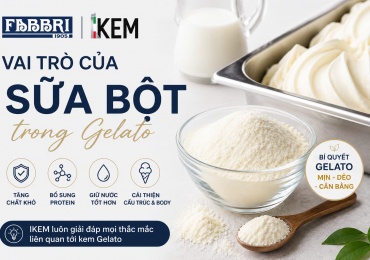
Milk powder
Protein
Fat
Sugar
Cocoa
Fiber
Fruit puree
Flavor pastes
all contribute to the total solids of the mixture.
If total solids are too low, the amount of free water may be too high.
During freezing:
Low total solids
→ More free water
→ More water freezes
→ Ice crystals develop
→ Gelato becomes hard
This is why a recipe containing “too much water and too little solids” often struggles to achieve a smooth and elastic texture.
Fat contributes to the sensations of:
richness – smoothness – creaminess – fullness
If the fat content is too low, Gelato may feel:
Cold
Thin
Less creamy
Less smooth
However, if the fat content is too high, Gelato may become:
Heavy on the palate
Less expressive in flavor
Unsuitable for certain fruit-based recipes
Inconsistent with the desired texture
Therefore, you cannot simply say:
“If Gelato is hard, increase the fat.”
Fat must be balanced with:
water + sugar + total solids + protein + Stabilizer + Emulsifier
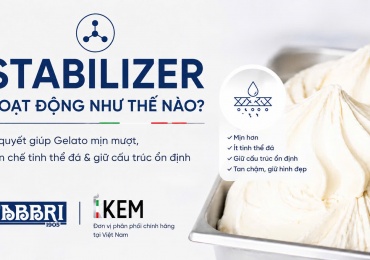
Stabilizers are commonly used to help:
Control water
Stabilize the structure
Limit the development of ice crystals
Improve smoothness
Improve shape retention
However, there is a common misconception:
“If Gelato is hard, just add more Stabilizer.”
This should not be done based on guesswork.
If used incorrectly, Gelato may become:
Too thick
Sticky
Heavy
Less natural in texture
What matters is not simply whether Stabilizer is used, but:
the right type + the right dosage + the right method of use + suitability for the recipe
Fruit Gelato requires special attention because each type of fruit contains different amounts of water, natural sugars, and solids.
For example:
Mango
Strawberry
Passion Fruit
Lemon
Blueberry
Peach
Melon
cannot automatically use the same recipe ratio.
When you change the amount of puree, you are simultaneously changing:
Water
Sugar
Total solids
Acidity
Texture
PAC/POD
Therefore:
A strawberry Gelato recipe cannot necessarily be applied directly to mango or passion fruit Gelato.
This is one reason why specialized Bases for fruit Gelato and sorbet can help simplify the recipe-development process.
FABBRI offers a range of specialized Bases for Gelato and fruit sorbet. For example, Fruit Basegel is a milk-free powdered Base that FABBRI describes as being designed for fruit sorbet and used together with water and fruit.
This is a very common situation.
When Gelato first comes out of the machine, it may be:
soft – smooth – elastic – easy to shape
But after some time, it becomes:
hard – difficult to scoop – icy
Why?
Because Gelato continues to cool down after leaving the machine.
If the recipe has:
Low PAC
High water content
Low total solids
An unbalanced sugar system
then as the temperature decreases, the amount of frozen water increases.
The result:
The colder the Gelato becomes → the harder it becomes.
Therefore, if Gelato looks beautiful when freshly made but becomes hard after several hours, check all of the following:
PAC – POD – water – total solids – fat – Stabilizer
Is the batch freezer operating consistently?
Is the actual temperature appropriate?
Is the Gelato experiencing temperature fluctuations?
Even a well-balanced recipe can feel too hard if the storage conditions are not appropriate.
Remember:
The recipe determines how the Gelato structure is formed; temperature determines how that structure behaves during serving.
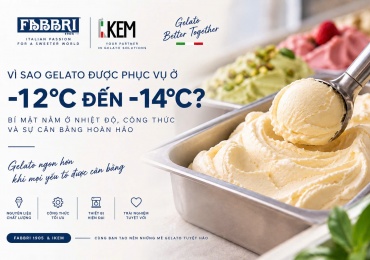
If the freezer is too cold:
More water freezes → Gelato becomes harder.
In addition, temperature fluctuations can affect the structure.
For example:
Freezing → temperature rises → partial melting → refreezing
Repeated too many times can cause larger ice crystals to develop.
Therefore, a good Gelato freezer does not only need to be cold. It also needs to be stable.
A good recipe can still produce an undesirable texture if the freezing process is not appropriate.
The goal of freezing is to create small ice crystals and a stable structure.
If the process is not properly controlled, ice crystals may become larger.
As a result, Gelato may become:
Coarse
Hard
Crumbly
Less creamy
Icy
This is why Gelato makers should view the recipe and the equipment as interconnected parts, rather than treating them separately.
| Symptom | Cause to Check |
|---|---|
| Hard immediately after coming out of the machine | Recipe or freezing process |
| Soft when freshly made but hard after several hours | PAC, water, total solids, temperature |
| Many ice crystals | High free water or temperature fluctuations |
| Crumbly, dry Gelato | Unsuitable total solids/recipe |
| Gelato is very sweet but still hard | Unbalanced sugar system |
| Gelato is too thick | Stabilizer/total solids may be too high |
| Fruit Gelato is hard | Water and total solids are not properly balanced |
| One batch is soft while another is hard | Weighing or process inconsistencies |
| Gelato quality deteriorates quickly | Storage conditions or temperature fluctuations |
First, check PAC and POD.
Do not look only at the total amount of sugar.
Calculate water coming from:
Added water
Milk
Puree
Fruit juice
Other ingredients
Check whether the recipe contains an appropriate amount of:
sugar + protein + fat + milk powder + fiber + other solids
Do not increase the dosage without proper calculation.
Make sure you have:
the right type – the right ratio – the right method of use
Measure the actual temperature instead of relying only on the number displayed on the freezer.
Pay particular attention when:
The freezer is opened frequently
The freezer is overloaded
Gelato is frequently taken out
The freezer has an unstable temperature cycle
Building a Gelato recipe from scratch requires consideration of many factors:
Water → sugar → PAC → POD → total solids → fat → protein → Stabilizer → Emulsifier → temperature
For beginners, this can be a complicated task.
That is why FABBRI 1905 offers a diverse range of Gelato Bases.
According to official FABBRI information, its Bases are selected according to various criteria, including hot/cold production methods, dosage, flavor profile, milk powder, fat, protein, fiber, Stabilizer, Emulsifier, and sugar system.
This allows Gelato makers to select a Base that is appropriate for a specific type of Gelato instead of having to build everything from scratch.
FABBRI Base Simplé G.S. is presented by FABBRI as a complete Base for lactose-free fiordilatte Gelato, used with a cold method.
Meanwhile, Fruit Basegel was developed by FABBRI for fruit sorbet and is combined with water and fruit.
The key point is:
Not all Bases are the same, and not every Base is suitable for every recipe.
The Base should be selected according to the type of Gelato, production process, ingredients, and desired texture.
One of the biggest challenges for beginners is:
Not knowing where to start when balancing a recipe.
You need to learn:
How to calculate water
How to calculate total solids
How to calculate fat
How to calculate PAC
How to calculate POD
How to use Stabilizer
How to use Emulsifier
How to adjust fruit-based recipes
How to modify a recipe when changing ingredients
A suitable Base can help reduce the complexity of this process.
For example, FABBRI Base Simplé Gelato System is described by the company as a complete Base for balanced Gelato, with ingredients including sugar, glucose syrup, dextrose, maltodextrin, citrus fiber, Emulsifier, and Stabilizer.
This does not mean that Gelato makers no longer need to understand the recipe.
Quite the opposite.
The better you understand the recipe, the better you can choose the right Base and adjust the flavor profile accordingly.
A common misconception is:
“The more ingredients you add, the better the Gelato will be.”
In reality, that is not necessarily true.
A good recipe is one in which the components work together in balance.
For example:
Water needs to be controlled.
Sugar needs to match the desired sweetness and freezing point.
Total solids need to be sufficient to create structure.
Fat needs to be appropriate for the type of Gelato.
Protein contributes to structure and mouthfeel.
Stabilizer & Emulsifier need to be used appropriately.
And finally:
Freezing temperature + storage temperature must be appropriate for the product.
Imagine a Gelato recipe as a chair.
It has many legs:
Water
Sugar
Total solids
Fat
Protein
Stabilizer
Emulsifier
Temperature
If one leg is too short or too long, the chair becomes unbalanced.
Gelato is the same.
You cannot simply adjust one ingredient while ignoring all the others.
This is one of the most important principles when learning how to make Gelato:
Do not look for a “miracle ingredient” to fix hard Gelato. Look for the underlying cause of the imbalance in the recipe.
Ask yourself:
Is the Gelato difficult to scoop?
Does the Gelato become significantly harder after several hours?
Are ice crystals appearing on the surface?
Does the Gelato feel dry or crumbly?
Does the recipe contain a high amount of water?
Has PAC been calculated?
Has POD been checked?
Has total solids been calculated?
Is the Stabilizer dosage correct?
Is the storage freezer too cold?
Does the temperature fluctuate significantly?
Has the fruit-based recipe been rebalanced when the puree is changed?
If you answer “Yes” to several of these questions, the Gelato is likely experiencing an issue with recipe balance or storage conditions.
Making Gelato is not simply about putting ingredients into a machine and waiting for the final product.
Behind every smooth and elastic scoop of Gelato is an entire system of knowledge:
Ingredients
→ Recipe
→ PAC/POD balancing
→ Total solids
→ Stabilizer
→ Freezing
→ Storage
→ Final product
This is also why IKEM develops its training and consulting approach around understanding the principles rather than simply memorizing recipes.
IKEM is always ready to support Gelato makers with questions such as:
Why does Gelato become hard?
Why does Gelato develop ice crystals?
Why does Gelato melt quickly?
Why does Gelato fail to hold its shape?
What are PAC and POD?
How does the freezing point affect Gelato?
How does Stabilizer work?
How do you balance a Gelato recipe?
How do you choose the right Gelato Base?
How can you maintain consistent Gelato quality from batch to batch?
There is no single answer.
Gelato can become hard because of:
Excessive water
Low PAC
An unbalanced sugar system
Unsuitable total solids
Improper Stabilizer usage
An unbalanced fruit-based recipe
Suboptimal freezing
Storage temperature that is too low or fluctuates
Therefore, if your Gelato becomes hard, do not immediately increase the sugar, fat, or Stabilizer.
Go back and check the entire recipe.
Because great Gelato needs more than great flavor.
Professional Gelato needs to achieve a balance between:
Flavor – sweetness – softness – elasticity – smoothness – shape retention – stability
With its experience in developing Gelato ingredients, FABBRI 1905 offers a wide range of Bases that can be selected according to the production method, dosage, and ingredient system appropriate for different purposes.
And for IKEM, the goal is not simply to help you make one great batch of Gelato.
More importantly:
FABBRI 1905 – Italian Gelato Ingredients.
IKEM – Your partner on the journey to mastering the art of Gelato.
19.09.2026
29.08.2026
28.08.2026
26.08.2026
24.08.2026
21.08.2026
18.08.2026
15.08.2026
13.08.2026
10.08.2026
09.08.2026

07.08.2026
06.08.2026
06.08.2026
05.08.2026
05.08.2026
01.08.2026

31.07.2026
01.07.2026
27.08.2026